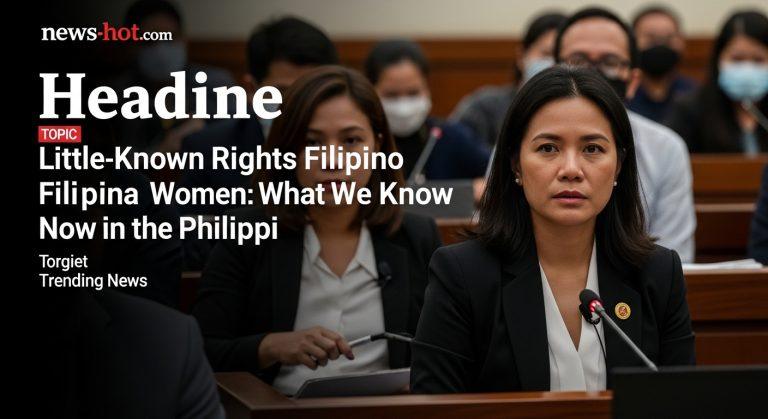
Editorial newsroom in the Philippines with a host presenting trending news analysis to camera.
Updated: April 9, 2026
Across the Philippine information landscape, the host Trending News Philippines operates as both guide and mirror, shaping how audiences interpret rapid-fire updates and official statements. In an era of smartphones and algorithm-driven feeds, viewers turn to trusted anchors to decode politics, economy, and everyday life. This deep-dive examines how this phenomenon functions, its implications for public discourse, and what stakeholders can do to improve clarity, accountability, and resilience.
Understanding the Trending News Ecosystem in the Philippines
News consumption in the Philippines is highly mobile, multilingual, and intensely social. Short-form clips, live streams, and captioned posts accelerate the spread of information—and occasionally, misinformation. Audiences rely on recognizable hosts to provide context, triangulate sources, and translate complex jargon into practical takeaways for viewers who may not have time to read full reports. This dynamic creates demand not only for speed but for credibility, a balance that the host Trending News Philippines is well positioned to pursue given the country’s regional diversity and entrenched media habits.
Beyond celebrity-driven moments, the ecosystem hinges on the perceived reliability of the host’s voice. When a host consistently clarifies sources, flags uncertainties, and invites follow-up questions, viewers are more likely to treat updates as starting points for informed decisions rather than definitive declarations. Conversely, when verification lags or speculation is presented without caveats, audiences may experience fatigue or mistrust. The challenge is not merely to inform but to scaffold understanding amid competing narratives.
The Host’s Role: Trust, Accessibility, and Responsibility
In a climate where the line between entertainment and information can blur quickly, the host’s authority depends on transparency as much as speed. A credible host contextualizes headlines with verifiable sources, discloses potential conflicts of interest, and updates earlier statements when new evidence emerges. Accessibility matters too: presenting in local languages, offering plain-language explanations, and using visuals that clarify rather than distort meaning. These practices are not optional add-ons; they shape how the public interprets risk, policy changes, and societal priorities. For the Philippines, where media literacy varies across regions, a responsible host can become a bridge—helping audiences discern what is known, what is uncertain, and what requires further inquiry.
Yet credibility also rests on institutional boundaries. The host should resist the temptation to overstate conclusions for dramatic effect, especially on topics with significant political or economic consequences. By adopting a clear sourcing framework and inviting external perspectives, the host can model healthy skepticism in a media environment that often rewards sensational hooks. In short, trust is earned not by presenting the boldest headline but by offering dependable scaffolding for judgment in everyday life.
Platform Dynamics and Audience Behavior in 2026
The mechanics of reach in 2026 hinge on algorithms, mobile data affordability, and the social nature of sharing. For a Philippine audience, video-first formats—clips, reels, and live streams—are particularly potent, but they also compress context. The host plays a crucial role in translating that compressed feed into stable, actionable insight. When platforms push content with high engagement but limited nuance, the host’s synthesis becomes a critical corrective—an editorial check that helps prevent misinterpretation during breaking events. The risk is that in the push toward immediacy, important caveats—or evidence-based updates—get buried under the next surge of attention-grabbing content.
Furthermore, localization matters. Text cross-posts and subtitles in Filipino, Cebuano, Ilocano, and other languages expand reach but require quality control to avoid misinterpretation. Audience behavior—commentary, questions, and crowdsourced fact-checks—can augment the host’s work if channeled through moderated, transparent dialogue. When this happens, the platform ecosystem can become more resilient to manipulation, because a community of engaged viewers co-constructs meaning rather than passively consuming a single narrative.
Policy, Platform, and Practical Implications
Policy and platform design should align with the Philippines’ diverse information needs. Key practical implications include: encouraging media literacy programs that teach critical evaluation skills from an early age; promoting transparent sourcing and corrections policies within news channels; and supporting multilingual accessibility so audiences can engage with the same material in their preferred language. At the organizational level, outlets and hosts benefit from publishing a clear set of editorial standards—explaining when updates are issued, how conflicts of interest are managed, and how data is sourced. While regulations may vary, the overarching aim remains the same: to foster a media environment where factual accuracy, accountability, and public service orientation coexist with rapid information flow.
In the Philippine context, collaboration among hosts, platforms, educators, and civil society can strengthen resilience against misinformation without dampening legitimate rapid-response reporting. A practical path forward includes standardized disclosure practices, routine post-publication corrections, and accessible explainers that help the public distinguish between confirmed facts, evolving narratives, and opinion. This approach not only protects viewers but also reinforces the credibility of the host at a time when trust in media is a hyper-local yet globally observable concern.
Actionable Takeaways
- For viewers: cross-check information with multiple credible sources and rely on the host’s cited references rather than single posts as the basis for decision-making.
- For hosts: publish sourcing notes, acknowledge uncertainties, and issue timely corrections when new information becomes available.
- For platforms: promote transparent labeling of verified vs. evolving information and invest in multilingual captioning that preserves nuance.
- For educators and media-literacy programs: integrate practical exercises that simulate real-time news analysis, source evaluation, and constructive discourse.
- For policymakers and regulators: support initiatives that strengthen media literacy, protect journalistic independence, and encourage responsible platform design without stifling legitimate rapid reporting.